Axis and Angle is one possible way to represent the rotation of a solid 3D object. Other representations are:
Description
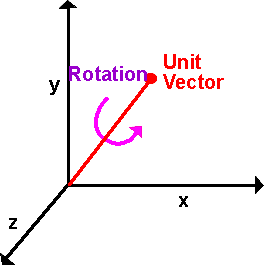
Rotation can be represented by a unit vector and an angle of revolution about
that vector.
Any 3D rotation can be represented in this way, in other words, given a solid
object with orientation 1 and the same object with a different orientation 2.
Then we can always find an axis and angle which will rotate from orientation
1 to orientation 2.
Which direction of rotation is positive? on this site, we will use the right
hand rule.
Axis-Angle is probably one of the most easily understood methods for us to specify 3D rotations. However, be careful, 3D rotations can be counterintuitive in some ways (see box on right of page). One downside of using axis angle to represent 3D rotations is that we can't directly combine two rotations to give an equivalent total rotation, to do that we need to use matrices or quaternions, quaternions are related to axis angle so its not too hard convert between them as explained here. The other downside is that there are two singularities at 0° and 180° where the axis can jump suddenly for a small change in input.
We can also use axis and angle to represent any instantaneous angular velocity
as
explained here.
Generalisation to other numbers of dimensions
Rotation in 1 dimensional space: we cant rotate in one dimension so that does not apply.
Rotation in 2 dimensional space: we only need the angle, the axis is not needed because we only have one plane to rotate in.
Rotation in 3 dimensional space: as covered on the rest of this page.
Rotation in 4 or more dimensional space:
Any rotation can be represented by projecting the object onto a 2-dimentional plane and then rotating it through an angle. The plane can be defined by a bivector .It happens that, in three dimensions, a bivector is three dimensional, in this case planes (represented by bivectors) and lines (represented by vectors) are duals. This means that, in three dimensions, we can represent the direction of rotation by a line known as the axis. This can be helpful as it can be more intuitive to represent the direction of rotation about an axis rather than in a plane.
sfrotation
On these pages will be developing a class sfrotation (full
listing here) which holds a rotation and encapsulates operations such as
combining two rotations, in addition to coding the rotation as a quaternion
it can also be coded as euler
or axis angle
and can convert
between these formats.
Sample Rotations
In order to try to explain things I thought it might help to work out a simple
case where rotations are only allowed in multiples of 90°. This should
make it easier to illustrate the orientation with a simple aeroplane figure,
we can rotate this either about the x,y or z axis as shown here:
When we combine these rotations about the x,y and z axis in 90° multiples
there are 24 possible orientations as shown here:
Axis-angle in all the rows below represents the rotation from the top left (reference orientation) to the position in the box concerned.
heading applied first giving 4 possible orientations:
|

reference orientation
angle = 0°
axis = 1,0,0 |

rotate by 90° about y axis
angle = 90°
axis = 0,1,0 |

rotate by 180° about y axis
angle = 180°
axis = 0,1,0 |

rotate by 270° about y axis
angle = 90°
axis = 0,-1,0
or
angle = -90°
axis = 0,1,0 |
Then apply attitude +90° for each of the above: (note: don't forget that all these axis-angle values are with repect to the reference orientation in the top row).
|

angle = 90°
axis = 0,0,1 |

angle = 120°
axis = 0.5774,0.5774,0.5774 |

angle = 180°
axis = 0.7071,0.7071,0 |

angle = 120°
axis = -0.5774,-0.5774,0.5774 |
Or instead apply attitude -90° (also a singularity):
|

angle = 90°
axis = 0,0,-1
(equivalent rotation to:
angle = -90°
axis = 0,0,1) |

angle = 120°
axis = -0.5774,0.5774,-0.5774 |

angle = 180°
axis = -0.7071,0.7071,0 |

angle = 120°
axis = 0.5774,-0.5774,-0.5774 |
Normally we don't go beyond attitude + or - 90° because these are singularities,
instead apply bank +90°:
|

angle = 90°
axis = 1,0,0
|
angle = 120°
axis = 0.5774,0.5774,-0.5774 |

angle = 180°
axis = 0,0.7071,-0.7071 |
angle = 120°
axis = 0.5774,-0.5774,0.5774 |
Apply bank +180°:
|

angle = 180°
axis = 1,0,0 |

angle = 180°
axis = 0.7071,0,-0.7071 |

angle = 180°
axis = 0,0,1 |
angle = 180°
axis = 0.7071,0,0.7071 |
Apply bank -90°:
|

angle = 90°
axis = -1,0,0
(equivalent rotation to:
angle = -90°
axis = 1,0,0) |
angle = 120°
axis = -0.5774,0.5774,0.5774 |

angle = 180°
axis = 0,0.7071,0.7071
|
angle = 120°
axis = -0.5774,-0.5774,-0.5774 |
encoding of these rotations in quaternions
is shown here.
encoding of these rotations in matrices is
shown here.
encoding of these rotations in euler angles is
shown here.
Further Reading
You may be interested in other means to represent orientation and rotational
quantities such as:
Or you may be interested in how these quantities are used to simulate physical
objects:

|
metadata block
|
|
|
| see also: |
|
| Correspondence about this page |
|
|
Book Shop - Further reading.
Where I can, I have put links to Amazon for books that are relevant to
the subject, click on the appropriate country flag to get more details
of the book or to buy it from them.
|
Mathematics for 3D game Programming - Includes introduction to Vectors, Matrices,
Transforms and Trigonometry. (But no euler angles or quaternions). Also includes
ray tracing and some linear & rotational physics also collision detection
(but not collision response).
Other Math Books
|
|
Commercial Software Shop
Where I can, I have put links to Amazon for commercial software, not
directly related to the software project, but related to the subject being
discussed, click on the appropriate country flag to get more details of
the software or to buy it from them.
|
|
|
Can you help?
Please send me any improvements to
here. I would appreciate ideas to make the pages more useful including
error correction, ideas for new pages, improvements to wording. It helps
if you quote the full URL of the page.
|
Can anyone help me prove any rotation can be represented in this way?
|
|
progam
I am working on a project which uses these principles, if you would like
to help me with this you are welcome to join in, here:
|
http://sourceforge.net/projects/mjbworld/
|
This site may have errors. Don't use for critical systems.